 ChatGPT
 Claude
 Perplexity
 Google AI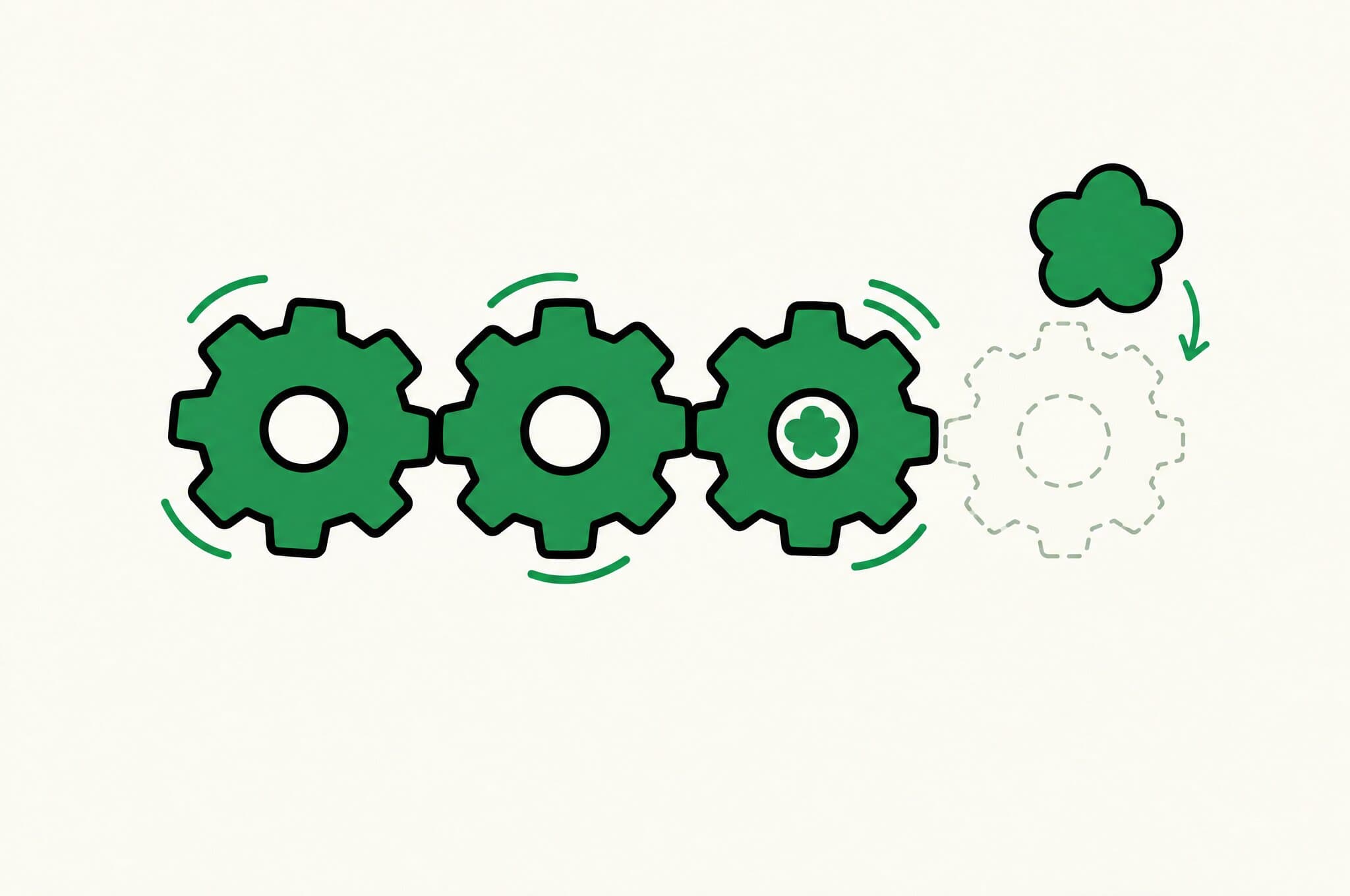
On this page
A founder I talked to this spring runs what looks, from the outside, like the future everyone is promising. He is solo. An AI coding agent writes most of his product; he reviews and ships. An AI support agent handles his inbox and resolves the routine tickets. On the engineering and support side, his company genuinely operates like a team of several people with one human in the loop. And then he described his growth, and the future evaporated: he does it all by hand, in the cracks between everything else, and it is stuck. "I automated the two things everyone said were hard," he said, "and the thing that's actually killing me is getting customers."
That gap is the most important unsolved problem in the whole autonomous-business story, and almost nobody names it. The zero-person company, the one-person unicorn, the business that runs itself — the vision is everywhere, and it is real for two of the three functions that make a company. AI can do the engineering. AI can do the support. AI cannot yet do the growth, and growth is the function that decides whether the company exists at all. Marketing is the bottleneck to the autonomous business, and closing it is a different kind of problem than the ones already solved.
Two of three functions fell. One didn't.
Strip a company to its core and it does three things: it builds a product, it keeps its customers working, and it goes and gets more of them. The last few years quietly automated the first two. Coding agents now take a specification and produce working software, because code has a clear target and a checkable result — it compiles or it does not, it passes the test or it fails. Support agents now resolve a large share of tickets, because a support question has a knowable answer sitting in the docs and the history.
Growth has neither property, and that is why it held out. There is no specification for "get me customers." There is no unit test that tells you the campaign was correct. The work is open-ended, the feedback is slow and noisy, and success is defined by a market that will not tell you the answer in advance. The two functions that fell to AI were the ones shaped like problems AI is already good at. The one that resisted is shaped like a different thing entirely.
Marketing is a loop, and tools automate tasks
Here is the precise reason growth is hard to automate: it is not a task, it is a loop. A task has a beginning and an end — write this post, draft this email. A loop runs continuously and feeds itself — try a channel, measure what happened, learn from it, move the effort, and carry the lesson into the next attempt, forever. The real job of marketing was never the individual post or email. It was running that loop across every channel at once, where what you learn in outbound reshapes the ad, and the article that ranks becomes the sales pitch.
Most of what gets called AI marketing automates a single step inside the loop and leaves the loop itself to you. A tool writes ad variants; you still decide the strategy, the audience, and the budget. A tool drafts a blog post; you still choose the topic, judge the result, and figure out what it taught you. This is the difference between the two meanings of using AI for marketing: a tool you prompt makes you faster at the steps, while an agent that runs the loop does the job. The first is a better instrument. The second is the missing function. Ten AI marketing tools with ten separate memories do not add up to a growth employee — they recreate the disconnected stack you were already gluing together, just faster.
Why the loop has to be one brain across channels
The reason a single agent running everything beats a stack of specialized tools is that what resonates is a fact about your market, not about a channel. When a tagline works in ads, that is not an advertising insight — it is a discovery about what your customers care about, and it belongs in your email subject lines, your landing page, and your outreach the same week. When an objection keeps appearing in cold replies, that is not an outbound problem — it is a signal that should reshape an article and a page. The channels feed each other, but only if one brain sees all of them and carries the lesson across.
A single-channel tool cannot do this by construction; it sees only its own lane, so it caps out at okay results for a narrow set of businesses. And this is also why the autonomous-business version of marketing has to be general across business types, not built for one vertical. You cannot know in advance whether a given company grows through search, or short-form video, or outbound, or referral — that has to be found by testing. A growth function that presupposes the channel is not autonomous; it is a bet the founder placed before the agent even started.
What stays human, even when it runs itself
None of this means the founder disappears from growth. It means the founder's role narrows to the part that was always theirs: judgment. Even a fully autonomous growth function does not decide what the company stands for, what it is willing to claim, how it is priced, or which piece of feedback is worth acting on. Those are not execution; they are taste and strategy, and handing them to software is neither possible nor desirable.
So the autonomous business is not actually zero-person in the function that matters. It is one-person, where the person does judgment and the agent does everything else. That is the same deal you strike with a great growth hire: they bring the throughput, running more experiments and producing more work than you ever could, and you keep the final call. The practical form of that call is an approval gate: every dollar of spend waits for a yes, and the founder decides which other kinds of work wait too. Autonomy in the execution, authority in the human. The founder stops doing the growth work and starts directing it.
Where Revnu fits
This is the whole reason Revnu exists. You can say "code me an app" to an AI agent today and watch it happen; you cannot yet say "get me customers" and have it happen, and that missing sentence is the last thing standing between the current moment and the autonomous business. Revnu is built to be that sentence: you plug it into your business and it runs the growth loop the way a hire would: proactively, showing up each day to read yesterday's numbers, decide what to try across SEO, ads, outbound, and social, do the work, and learn from the result, all as one agent with one memory. It does the execution. Your first sequence always waits for your yes. After that, Settings > Agent decides what asks first. Replies to prospects, spend, budgets, booking links and new inboxes always wait. It is not a capability you operate. It is the function that was missing.
Where this leaves you
If you are building toward a company that runs on as little manual labor as possible, you have probably already noticed the asymmetry: the engineering and the support bend to AI, and the growth stubbornly does not. That is not a failure of your effort; it is the shape of the problem, and it is the frontier the whole industry is standing at. The move is to stop treating marketing as a pile of tasks to speed up and start treating it as a function to hand off — the loop, not the post. Keep the judgment that was always yours: what the company says, what it charges, what it believes. Delegate the relentless execution that collides with everything else you do. The autonomous business is two-thirds here. The missing half is growth, and closing it is what turns "code me an app" into a company. See what running that half looks like on the features page.
Written by

Co-founder, Revnu