AI marketing
How to Use AI for Marketing: A Founder's Playbook
On this page
- SEO content is the channel where AI earns its keep fastest
- Paid ads: AI writes the variants, you set the strategy
- Cold outbound: personalization at volume, judgment on the list
- Social and short-form: AI repurposes, taste still decides what ships
- Lifecycle and retention: where AI quietly outperforms a human
- How to keep AI from producing slop: voice, facts, review
- Where AI still needs a human, plainly
- Stop stitching ten tools together
A founder I know shipped a developer tool in March, then spent six weeks doing nothing but coding because marketing felt like a second job he had no time for. By the time he looked up, two competitors with worse products had eaten the keyword he should have owned. He did not lose on engineering. He lost on distribution. That is the trap most technical founders walk into, and it is the reason figuring out how to use AI for marketing matters more than picking the perfect framework.
Here is the honest version. AI will not run your marketing for you with zero judgment. It will, used correctly, take the repetitive execution off your plate so you ship five times the volume per week. This playbook is organized by channel. For each one I will tell you what AI does well right now, where it still needs a human, and a workflow you can start today.
SEO content is the channel where AI earns its keep fastest
Start here because the math is the most forgiving. A founder writing one decent blog post takes four hours. The same founder directing an AI draft, then editing for voice and facts, ships three posts in that window. That is the actual gain: not free content, faster content with you still in the loop.
What AI does well: keyword clustering, outlining around real search intent, first drafts, internal link suggestions, and meta tags. Pair it with Ahrefs or Google Search Console for the keyword data and AI for the drafting, and you have a working pipeline by Friday.
Where it produces slop: generic intros, invented statistics, and posts that sound like every other AI post because the model defaults to its own beige voice. Fix this by feeding it three of your own writing samples and a banned-phrase list, then fact-checking every number against a primary source before publish. (Enterprise content teams pay platforms like Jasper to solve the same voice problem with governance; below that scale, the samples and the banned list get you most of the way.)
The workflow to run this week: pull your top 20 keyword opportunities, cluster them into 5 topics, draft one post per topic, then edit hard for voice and accuracy. If you are early and have no traffic yet, read getting your first customers before you optimize for search volume you cannot rank for yet.
Paid ads: AI writes the variants, you set the strategy
Google Ads and Meta both ship AI features that will happily spend your budget. The mistake is letting the platform's automation pick your audience and your offer. That is the part you own.
Where AI genuinely helps: generating 20 headline variants instead of 3, writing landing page copy matched to each ad angle, and reading the results to flag which creative is converting. Ad testing is a volume game, and volume is exactly what a human writing one ad at a time cannot produce. AI gives you the spread to actually learn something.
Where you stay in charge: the wedge. Which customer pain you target, what you are willing to pay per signup, and whether the offer is even right. AI can write 50 versions of a bad offer faster than you can write one. Speed amplifies a wrong strategy.
Run this: pick one campaign, one audience, three distinct angles (pain, outcome, status quo). Have AI write 8 headlines and 4 descriptions per angle. Launch, let it run a week, kill the bottom half, double the budget on the winner. The named mechanism here is the kill rule: a fixed threshold (say, cost per signup above 2x target) that retires losers automatically so you are not emotionally attached to a dud.
Cold outbound: personalization at volume, judgment on the list
Cold email died as a channel for the people who blasted the same template to 5,000 contacts. It works for the people who use AI to research each prospect and write a first line that proves they did. That is the split AI changed.
Clay plus an AI writing step is the common stack: enrich the lead, pull a recent signal (a funding round, a job change, a product launch), and generate an opener tied to that signal. The mechanism that makes this work is the signal, not the volume. A relevant first line to 200 people beats a generic blast to 5,000 every time.
Where AI fails you: list quality and deliverability. AI will write beautifully to a garbage list and torch your domain reputation doing it. You own the targeting (who actually has the problem), the domain warmup, and the decision about whether a prospect is worth contacting at all. Deliverability is plumbing, and AI does not fix plumbing.
Run this: build a list of 100 prospects who share one specific trait, enrich each with a real signal, generate personalized openers, and review every one before send. If a line reads like it could go to anyone, cut it.
Social and short-form: AI repurposes, taste still decides what ships
The fastest content gain most founders ignore: you already wrote a blog post, recorded a demo, answered a support question. AI turns each of those into five LinkedIn posts, ten tweets, and a short-form script. Repurposing is where AI compounds, because the source material is yours and already good.
For video, tools like ElevenLabs handle voiceover and captions cheaply, and AI can cut a long recording into clips around the moments that land. What it cannot do is know which clip is actually funny or sharp. That judgment is taste, and taste is the thing that makes social work.
Where the slop shows up: engagement-bait hooks that all sound the same, threads padded to hit a length, and the AI cadence that readers now spot instantly. Avoid it by writing your own hooks and letting AI fill the middle, not the reverse.
Run this: take your last blog post, have AI draft 5 LinkedIn posts from its strongest sections, rewrite the opening line of each in your own words, and schedule them across two weeks.
Lifecycle and retention: where AI quietly outperforms a human
Onboarding emails, win-back campaigns, usage-based nudges, churn-risk outreach. These are repetitive, triggered by events, and tuned by data. That is the exact shape AI handles best, and it is the channel founders most often neglect because it is unglamorous.
A concrete before/after: a founder running one generic welcome email versus a sequence branched by signup source and first-session behavior, each variant A/B tested on subject and timing. AI can build and run that sequence. A human would not have the patience to maintain it.
Where you still set the rules: the trigger logic and what counts as a healthy account. AI optimizes the message; you define the goal. Get the goal wrong (optimizing opens instead of activations) and AI will cheerfully hit the wrong target.
Run this: write one win-back email for users who went quiet 14 days after signup, let AI generate three subject-line variants, and send to a small cohort before rolling out.
How to keep AI from producing slop: voice, facts, review
This is the section that decides whether everything above works or embarrasses you. Three mechanisms, in order.
Voice: give the model your actual writing, three samples minimum, plus a banned-phrase list. The reason AI content reads as AI is that nobody fed it a voice, so it falls back to its training-data average. A voice file is the single highest-leverage fix.
Facts: AI invents statistics with total confidence. Every number, every quote, every "according to" gets checked against a primary source before publish. No exceptions. One hallucinated stat in a published post costs you more trust than ten posts buy.
Review: nothing auto-publishes until you trust the lane. Drafts go to a queue, you approve or kill, and over time you let the safe lanes run on their own. This is the model AI growth agents are built around, and it is why a review step is a feature, not a bottleneck.
| Channel | What AI does well | Where you still need a human |
|---|---|---|
| SEO content | Drafts, clustering, internal links | Voice, fact-checking, topic strategy |
| Paid ads | Variant volume, copy, result reading | Audience, offer, kill thresholds |
| Cold outbound | Per-lead personalization | List quality, deliverability, targeting |
| Social/short-form | Repurposing, captions, scripts | Hooks, taste, what to ship |
| Lifecycle | Sequences, A/B tests, triggers | Goal definition, account health |
Where AI still needs a human, plainly
The things AI cannot do yet are the things that actually matter most, which is the uncomfortable part. It cannot decide your positioning. It cannot feel that a campaign is technically fine but off-brand. It cannot know which of three good ideas is the one your specific customers will care about.
It also cannot own the outcome. When a launch flops, AI does not lose sleep or change strategy. You do. Treat AI as the team that executes your judgment at volume, not the judgment itself. The founders who get burned are the ones who outsource the thinking and keep the typing. Do the reverse: keep the thinking, outsource the typing.
The practical line: anything repetitive, triggered, or volume-dependent, hand to AI. Anything about brand, positioning, or what to build next, keep. That split holds across every channel above.
Stop stitching ten tools together
Read back through this playbook and notice the real cost. It is not any single channel. It is that running all of them means a keyword tool, an ad platform, an enrichment tool, a writing tool, a video tool, a lifecycle tool, and you, the founder, as the integration layer holding it together at 11pm. Each tool learns nothing from the others, which is exactly why marketing has resisted automation while coding and support have not.
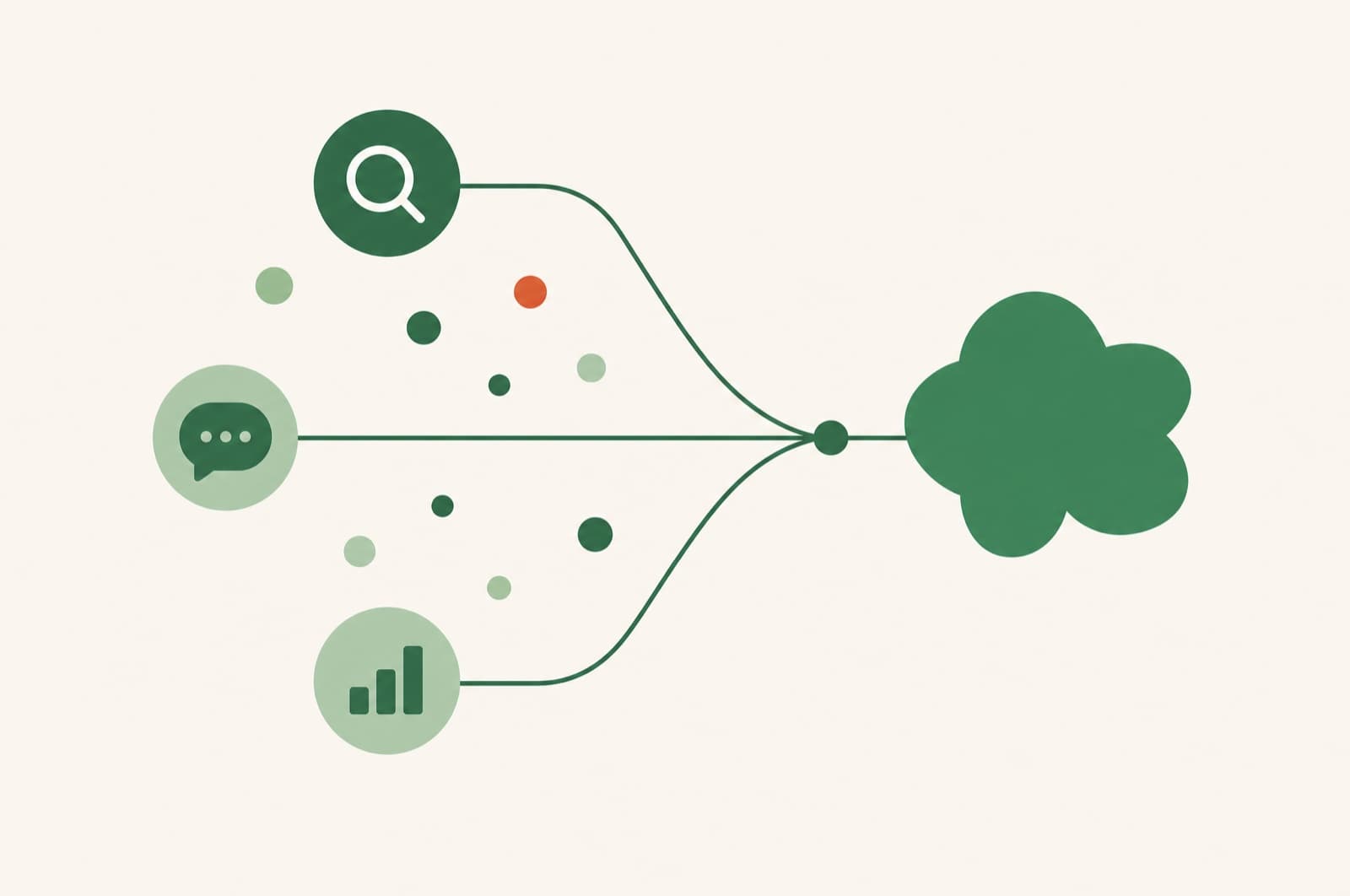
That is the problem Revnu solves. Revnu is an AI growth team for software startups: connect Stripe, GitHub, Slack or iMessage, and your site, and it reads your product, audience, and voice, then runs SEO, ads, outbound, social, and lifecycle as one learning loop. Drafts land in a review queue you approve in one tap, with auto-send optional per lane. Strategy stays yours. If you want to run AI marketing without an agency or ten dashboards, see what Revnu does on features and pricing, then connect your product and let it draft your first week.
Let Revnu run this for you.
Connect your product and Revnu drafts the SEO, ads, and outbound. You approve in one tap. Book a 30-minute call and see it on your stack.
Book a demoFrequently asked questions
Can AI fully run my marketing without me?
No, and any tool claiming it can is overselling. AI handles the repetitive execution: drafting, variant generation, sequences, and reading results. You keep strategy, positioning, and brand judgment. The working model is AI drafts, you approve, and you gradually let proven lanes auto-send. Keep the thinking, hand off the typing.
How do I stop AI content from sounding like AI?
Feed the model three samples of your own writing plus a banned-phrase list, so it stops defaulting to its training-data average voice. Then write your own opening lines and hooks, letting AI fill the middle. Finally, fact-check every number against a primary source. Voice plus facts plus a review step removes most of the slop.
Which marketing channel should a founder start with using AI?
SEO content, because the time math is the most forgiving and the work compounds. Directing AI drafts lets you ship roughly three posts in the time one used to take, with you editing for voice and accuracy. Start by clustering your top keyword opportunities, then draft and edit one post per cluster before expanding to ads or outbound.
Is AI-written cold email still effective?
Yes, when it is personalized off a real signal, not blasted. Use enrichment (Clay or similar) to pull a recent event per prospect, then have AI write an opener tied to that signal. The relevance is what works, not the volume. You still own list quality and deliverability, which AI cannot fix and will happily ruin with a bad list.
How is Revnu different from using ChatGPT for marketing?
ChatGPT drafts one thing at a time and forgets everything between sessions. Revnu connects to your product and tools, runs SEO, ads, outbound, social, and lifecycle continuously as one learning loop, and routes drafts to a review queue you approve from Slack or iMessage. It is the difference between a writing assistant and a growth team that executes.
Written by
Art Freebrey
Co-founder, Revnu