
On this page
Ask most people what AI does for marketing and you will hear the same answer: it writes the copy. You type a prompt, it gives you a blog post or a batch of emails, you paste them somewhere. That is real and it is useful, and it is also the smallest part of growth. Writing the words was never the bottleneck. The bottleneck is everything around the words: deciding what to write, running it across the right channels, reading what happened, and changing the next move because of it. A tool that only writes copy hands you the easy ten percent and leaves the hard ninety on your desk.
That gap is the difference between an AI writing tool and an AI growth agent, and it is worth being precise about, because the two get sold under the same word. This post is about what it actually takes to run multi-channel growth, SEO and ads and outbound at once, and why the part that matters is not the generation but the loop that connects the channels. Revnu is the concrete example throughout, because it runs this way and I would rather show the mechanics than gesture at them.
Writing copy is the easy part
Start with what a writing tool does, because it is genuinely good at it. You ask for ten landing-page headlines, you get ten. You ask for a blog post on a topic, you get a competent draft. The loop begins and ends with your hand on the keyboard: you decide, you prompt, you place the output. The tool is a faster pen.
Now notice everything the pen does not do. It does not decide that your changelog page is thin and three posts would catch buyers you are missing. It does not know which keyword you are close to ranking for, so it cannot aim. It does not ship the post, watch whether it ranks, or turn the one that worked into three more. It writes when asked and then waits. For a founder, that means the tool removes the typing but leaves the judgment, the targeting, the shipping, and the measuring, which is to say it leaves the actual work. The fuller spectrum from single-shot tools to agents is in how to use AI for marketing.
What "running a channel" actually involves
Take one channel, SEO, and lay out the real work, because the writing is one line in a long list. You have to research which queries your buyers search and which ones your young domain can realistically win. You have to decide which of those is worth a post this week. You have to draft it in a voice that sounds like you. You have to publish it, link it sensibly, and then wait and watch whether it ranks. And when one post climbs, you have to notice and seed three more around the same theme.
Only one step in that chain is "write the copy." The rest is decision, targeting, shipping, and learning. Now multiply the whole chain by three, because real growth is not one channel. Add paid ads, with its own targeting, copy, budget, and result-reading. Add outbound, with its research, personalization, sending, and follow-up. A writing tool helps with one step in each of three chains. The other steps, the ones that decide whether any of it works, are still entirely yours. That is why a stack of single-purpose tools leaves a founder so busy; the honest accounting of that is in one AI growth agent vs. a stack of point tools.
How an agent runs the full cycle
An AI growth agent runs the whole chain, not the one step. The cycle is four repeating moves, and naming them makes the difference concrete.
It researches. It reads your product, your customers, and your market, and forms a view on who to target and where. This is why the connection step matters: an agent that has read your real product and pricing aims, while a blank-prompt tool guesses.
It drafts. It produces the work across channels, the post, the batch of cold emails, the ad copy, each in your voice because it learned your voice from your site and messages.
It experiments. It does not ship one thing and hope. It runs the post and the ad test and the outbound batch, then measures what got opens, clicks, replies, and signups.
It learns. Results feed back into the next round of decisions. This is the move a writing tool has no concept of, and it is the move that turns three channels into one system.
| AI writing tool | AI growth agent | |
|---|---|---|
| Who starts the work | You, with a prompt | The agent |
| Scope | One draft at a time | SEO, ads, outbound together |
| Reads results | No | Yes |
| Changes its next move | No | Yes, across channels |
| What it needs from you | A prompt | A connection and approval |
The dividing line is the bottom three rows. A writing tool does what you asked and stops. An agent runs the cycle, sees what happened, and adjusts, which is the only way to actually run a channel rather than just feed it copy.
The part that compounds: one loop across channels
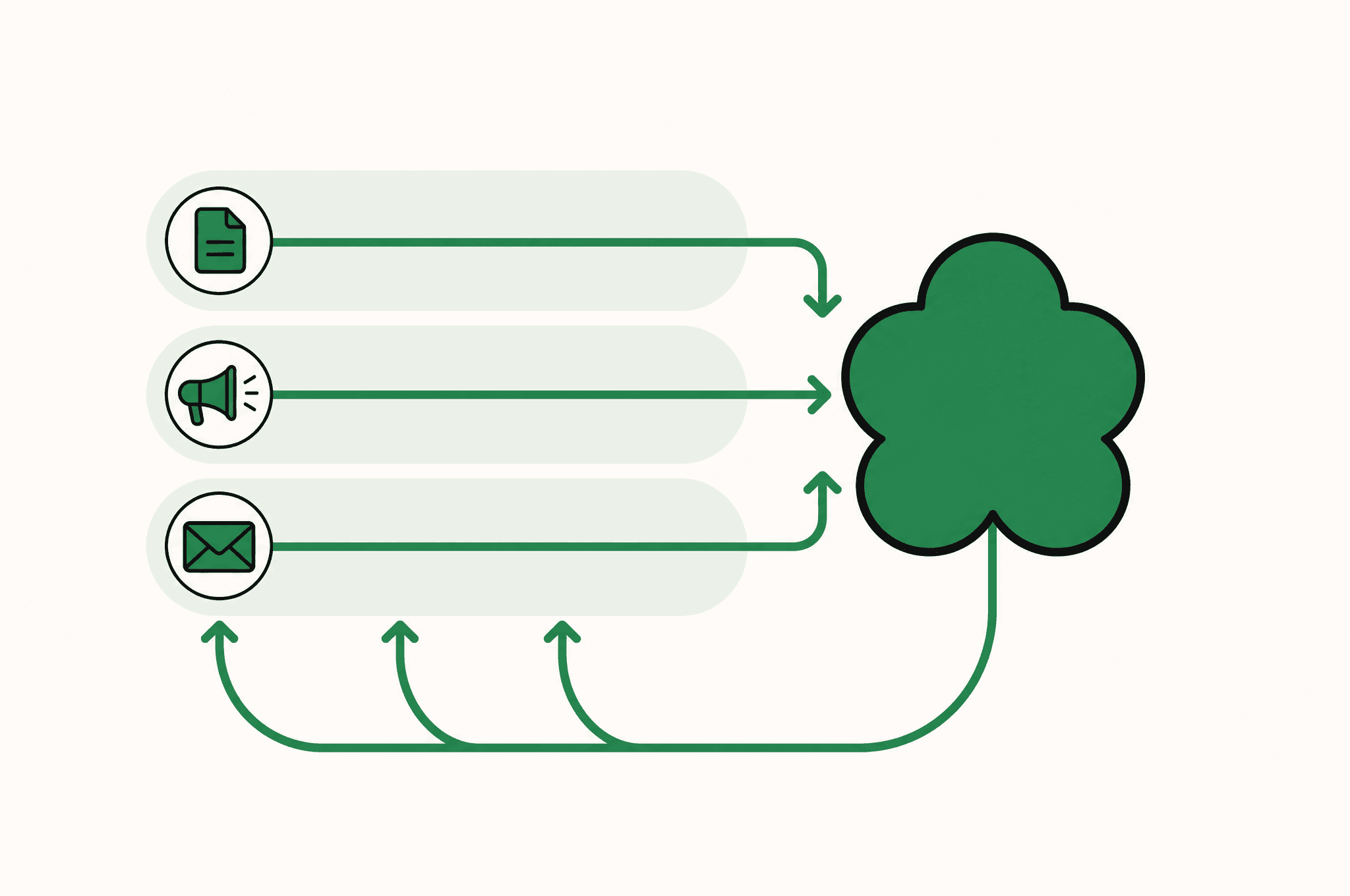
Here is the move that makes multi-channel growth worth more than the sum of its channels, and the part a writing tool cannot reach. When the channels share one loop, a lesson in one becomes an advantage in the others.
A subject line that earns replies in cold email becomes the ad headline you test next week. A keyword you finally rank for becomes the seed for three more posts and a fresh outreach angle. A pain point that keeps surfacing in replies becomes the subject of a post and the hook of an ad. Each channel feeds the others, so the work does not just add up, it compounds. The deeper mechanics of running the lanes as one system are in full-stack growth automation.
Now picture the same three channels run as separate tools. Your SEO tool gets better at SEO. Your ad tool gets better at ads. Neither improves because of the other, because neither can see the other. The only path for a lesson to travel between channels is through you, copying it from one dashboard to another between meetings, from memory, when you remember. Mostly you do not, so the signal is lost. That lost signal is the real cost of running channels as disconnected tools, and it is invisible because you never see the compounding you did not get. The loop is the whole point of an AI growth agent; the copy is just what flows through it.
You still approve everything
Running several channels does not mean handing over the wheel, and the design that makes that true is a review queue. Every draft the agent produces, every post, email, and ad, across every channel, lands in a queue before it goes anywhere. You approve it in one tap from Slack or iMessage, the place you already work. Nothing publishes, sends, or spends in your name until you say yes.
That gate is what makes a multi-channel agent usable rather than frightening. You are not trusting software to be tasteful at two in the morning; you are reviewing finished drafts and steering them. For lanes you come to trust, you can turn on auto-send so low-stakes work flows without a tap, while anything that carries real risk still waits for you. You get the throughput of software that never stops and the safety of a human signing off on what represents the company. The strategy stays yours; the production stops being your job.
Where this leaves you
AI marketing is not a faster pen. The pen was never the bottleneck. The work that grows a company is deciding what to do across channels, shipping it, reading the result, and letting each channel sharpen the next, and a tool that only writes copy does none of that. An AI growth agent runs the full cycle across SEO, ads, and outbound as one loop, and the loop is the part that compounds, because it is the only thing that carries a lesson from one channel to another without depending on a founder who is already out of time.
If you want to see the loop run on your actual product, connect Revnu to your site, your repo, and Slack, watch what it proposes across all three channels in the review queue, and approve the first thing that looks right. The writing is the easy part; the loop is what you have been missing, and it starts on day one.
Written by
Art Freebrey
Co-founder, Revnu